The First ASA Rulings for LHFD Rules Are In. Here Is What They Tell Us.

The Less Healthy Food and Drink advertising restrictions came into force in January 2026. Four months later, the ASA has published its first upheld rulings — against Lidl Northern Ireland and Iceland. Neither brand was doing anything unusual. That is the point.
Since the LHFD ad rules came in, the industry has been waiting for the first real test cases: not to see whether the rules would be enforced – that was never seriously in doubt – but to understand exactly how they would be applied in practice. Which formats would be caught? Who would be held responsible?
The April 2026 rulings are uncomfortable not because the ASA has taken an aggressive interpretive position, but because both upheld findings involve completely standard campaign executions – the kind that run hundreds of times a week across the industry. An influencer post promoting a bakery range. A dynamic display ad pulling from a live product feed. If those formats are in scope, so is a great deal else.
The Lidl Ruling: One Product Changes Everything

Lidl Northern Ireland paid influencer Emma Kearney (@babyemzo) to promote bakery products on Instagram. The post featured three items. Two were not HFSS. One, a Pain Suisse pastry was.
The Pain Suisse was shown in close-up, named and tasted on camera. The ASA classified it as a sweetened bread product meeting the HFSS threshold, which brought the entire post within scope of the LHFD rules. The presence of two compliant products made no difference. The brand-only exemption, which would have applied had the post promoted Lidl without identifying specific products, did not apply because one specific product had been clearly identified and that product was restricted.
Lidl Northern Ireland — April 2026
| Medium | Instagram influencer post (paid) |
| Influencer | Emma Kearney (@babyemzo) |
| Products | Pain Suisse ✕ HFSS | Cheese Pretzel (compliant) | Almond Croissants (background) |
| ASA finding | The Pain Suisse was clearly shown, verbally described and tasted by the influencer. As an identifiable HFSS product, it brought the entire post into scope. The brand-only exemption did not apply. |
| Key takeaway | One identifiable HFSS product is enough. The presence of compliant items alongside it is not a defence. |
The operational implication for influencer programmes is specific: a content brief that does not explicitly govern which products can and cannot be identified – by name, close-up or verbal description – is not a compliant brief. It does not matter if the influencer selects the products themselves, or if the HFSS item appears alongside five compliant ones. What matters is whether a restricted product is identifiable in a paid placement. If it is, the ad is in scope.
Practical implication: HFSS product eligibility needs to be part of the influencer brief, not an afterthought. Every product that could appear in frame should be pre-cleared and the brief should be explicit about which items must not be featured, named or described.
The Iceland Ruling: Automation Is Not a Defence
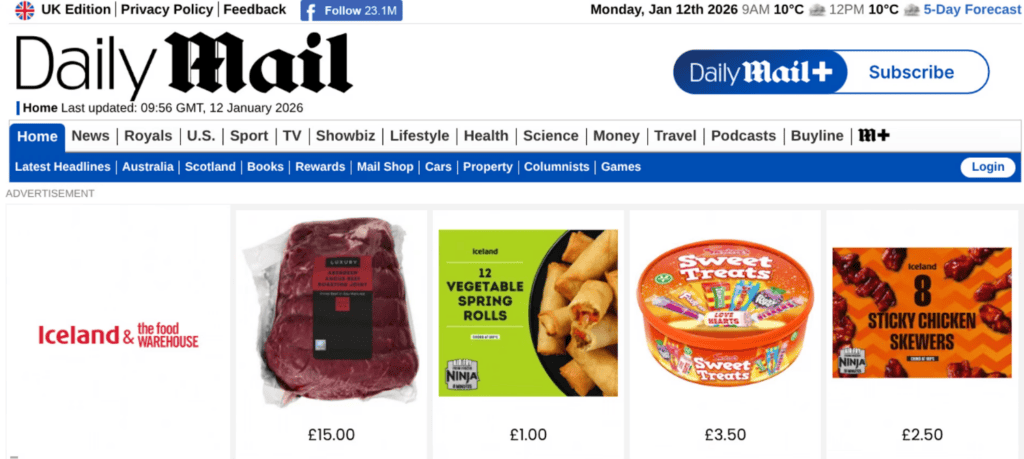
Iceland’s case raises a harder structural question. The ads – a banner and a display ad served on a (Daily Mail) website are understood to have used a dynamic product ad format, pulling items from a live range rather than featuring products selected for those specific placements. The HFSS products that appeared (Swizzels Sweet Treats in Ad A; Pringles, Chupa Chups and Haribo in Ad B) were not deliberately chosen. They were in the feed.
The ASA did not treat that as a mitigating factor. Paid-for online media featuring identifiable HFSS products is in scope, full stop. The mechanism that put those products in the ad is not relevant to the ruling. What the consumer saw is what the ASA judged.
Iceland — April 2026
| Medium | Paid banner and display ads (Daily Mail website) |
| Products (Ad A) | Aberdeen Angus Beef Joint (compliant) | Vegetable Spring Rolls (compliant) | Swizzels Sweet Treats ✕ HFSS | Sticky Chicken Skewers (compliant) |
| Products (Ad B) | Aberdeen Angus Beef Joint (compliant) | Pringles Sour Cream & Onion ✕ HFSS | Lurpak (compliant) | Chupa Chups Laces ✕ HFSS | Chooee DiscoStix ✕ HFSS | Haribo Elf Surprises ✕ HFSS |
| ASA finding | Multiple identifiable HFSS products appeared in paid-for online media. The automated nature of the format was not a defence against the breach. |
| Key takeaway | Dynamic ad formats are not exempt. If you do not control which products populate a placement, you do not control your LHFD exposure. |
PromoVeritas had this exact conversation with a large retailer in the weeks before these rulings were published: whether dynamic formats would be caught and how likely an upheld ruling would be. The answer is now on the public record.
The challenge dynamic formats create is not technical, it is organisational. A retailer’s live range may run to thousands of SKUs. HFSS classification is not static: it shifts as products are reformulated, as nutritional thresholds are updated, as new lines are added. Keeping a clean, current HFSS exclusion list and actively applying it to every dynamic placement is an ongoing process, not a one-time audit. That process has to sit somewhere and right now, in many businesses, it is not obvious where.
Practical implication: retailers running dynamic product ads in paid-for online placements need an active HFSS exclusion filter applied at feed level. A manual review of high-reach placements is a reasonable additional layer. Neither is optional.
What Changes Now
These rulings will not surprise anyone who has been following the LHFD rules closely. But they do shift the position for teams who have been operating on the assumption that enforcement would start with more obviously promotional content, or that dynamic formats were a lower-priority concern.
The more significant shift is in where compliance ownership needs to sit. Both rulings involve formats that cross organisational boundaries: influencer campaigns touch marketing, legal and procurement; dynamic product ads sit at the intersection of media buying, trading, tech and legal. Under the old CAP Code framework, compliance decisions at that intersection could reasonably be deferred or distributed.
Under LHFD restrictions, with upheld rulings now public and searchable, that deference has a cost that is no longer theoretical.
The brands and retailers running the most defensible campaigns in 2026/27 will be the ones that have asked and answered one clear question before anything goes live: Do we actually know which of our HFSS products are appearing where?
PromoVeritas works with retailers and brands on the compliance infrastructure behind promotional and advertising activity including claims and copy review, influencer governance, Terms & Conditions drafting and legal and regulatory advice across more than 90 markets.
If the LHFD rulings raise questions about how your current activity is structured, get in touch or see how we have delivered for brands including Cadbury, Amazon and Corona in our case studies.
- Email us:
- info@promoveritas.com
- Call us:
- +44 (0)203 325 6000
- Write to us:
PromoVeritas Ltd, Monument House,
215 Marsh Road, London, HA5 5NE, UK
SOURCES: ASA ruling — Lidl Northern Ireland GmbH & Co. KG (April 2026); ASA ruling — Iceland Foods Ltd (April 2026); ASA LHFD rules guidance (October 2025); CAP Code Section 15 (Less Healthy Food and Soft Drinks). Link directly to asa.org.uk ruling pages before publication.